Showing posts with label experiment. Show all posts

Tuesday, April 16, 2013

A Fairy Tree House

One thing leads to another...

I bought a drill bit thing-a-ma-jig to cut circle shaped holes out of wood.  

Probably has more comprehensible (shorter!) name?

I wanted to cut pieces of birch different lengths and then drill plant-pot holes in the top. (I saw a centerpiece holding candles somewhere for inspiration.) Unusual Container ideas were floating around in my head for the coming Virtual AV Show! :)

So I played with polymer clay, baked, drilled, chiseled, whittled, cussed, applied band-aid, wood-glued.   
And produced this crafty piece of art. shush now!

Not exactly how I first envisioned it, but working fairy doors are going to take a little more planning.  Plus, round logs are harder to glue flat things to than I thought <grins>.
 
Plant is my sporty version of  
Ness' Fantasy Gold. 

Not much fantasy, but I finally got some "gold" - except every bloomstalk puts out a different colored flower on all 4 or 5 plants I've grown so far. And then very quickly the yellow turns into a ghastly orange/dead brown blossom?

This imitation palm-tree had it's rootball severely trimmed in order to play doll house fit.    May not be long for this world.   

BUT there's a couple more just like it on the plant shelf.  I'm hoping the next round of blooms on one of them will improve: pick a nice version and stick to it!

Sunday, April 14, 2013

I Hunted; I Gathered.

Shake off the April snow...

I've been watching for the ingredients to use in a dish garden on my daily nature walks with the dog since last fall. Dropped acorns and moss that fell from the trees during all the high winds we've had this winter were gathered into mittened fingers, as I tried to juggle my collectibles with Jax's leash plus treats needed to convince her leashes are part of the routine at the end of our walk. (NO, you may NOT top off your 20 minutes of freedom in the field and woods by running across the road to the neighbors!)

I've had this piece of driftwood for a very long time, intended for my attempt at a natural dish garden someday. (It has a few teeth marks at the top as I've removed it from Jax's mouth at least twice.)
Yesterday I finally felt up to the project - with both spare time and the extra energy - so went off to gather moss, fungi and rocks I had "bookmarked" along our path.

EXCEPT it snowed a little the night before.
Gathering took more hunting than I thought it would!

This week Violet Voice members are putting together a mini-virtual African Violet show practice run ahead of the show planned for later. 
I've been DISBUDDING most of my plants for later.
Not many of them are in full bloom right now!

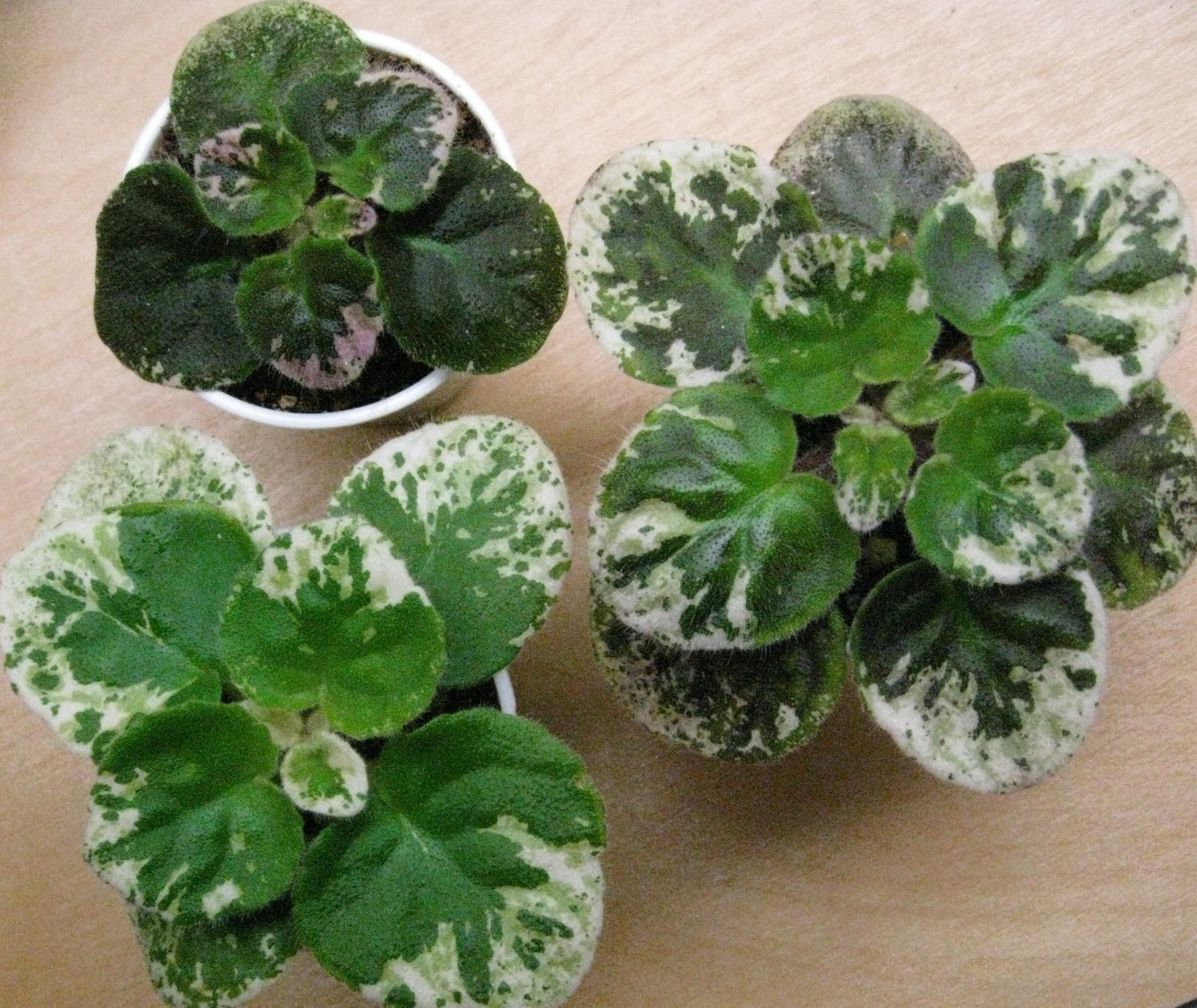
The plant used in this dish was supposed to be Optimara Little Moonstone.
I grew out 6 or 8 babies from the 2 leaves that survived the Round Robin exchange last fall. ONLY 1 from all I grew out bloomed true.
(A now proven argument for keeping more than one or two baby plants! The one blooming correctly was the only one with lighter colored leaves. I might have mistaken it for the "runt" and discarded it had I tried to decide which to cull sooner.) 

Most of them bloomed double solid purple.
A few have just a hint of the Cruella DeVille streak of white. ;)

Thursday, January 10, 2013

When the obvious stares back at you...

Temperature control and a bit of humidity can't hurt! 

In the past, growing plants under domes hasn't worked that well for me. 
The climate inside tends to be too moist.  
Self-confessed hoverers tend to over-water?
Condensation is generally excessive. 

I looked at 2 trays side-by-side on the shelf the other day and realized Tiger Trail babies under a vented dome were growing faster than than those in open air.  

Well, what do you know?! 

I went and found an extra dome for the tray without one. I do have the ends propped open with clothespins for maximum venting. 
And I'm trying hard to resist watering too much!

Temperatures are below seasonably cold right now and the wood stove gives the thermostat a false sense of what's "warm enough" for the rest of the house. 

I'm stubbornly nurturing ALL of these as treasured prizes and ignoring the "limit your collection" resolution for this variety. 
Never mind pointing out how big they'll get! 

The cream colored variegation seems to holding well for the ones that started that way. The pink tinged ones seem to be consistent as well. 
I like them all! 

I think I put one in a box I was packing to send home with Sara after Christmas.
And then I took it back.  How stingy?!
Nobody asked me, but ...

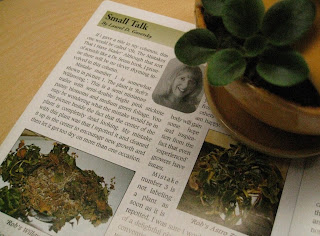
The latest issue of AVSA's magazine is out.
People are putting it down asking for hugs it's that depressing.
It was probably not by design that so many of the articles are about dead plants or terminal AV diseases that there's no cure for.
It's the dead of winter for many of us.
A little Hope & Hurry up Spring would have gone a long way to lift the spirits!

Even the lady who took over the Miniature column showcased what she called "mistakes".

I'm sorry... those are some seriously neglected plants.

The Thinking Small column was always my favorite of the magazine when written by Pat Richards.

Small Talk seems to suffer from "it's all been said before" syndrome.
Or "confession is good for the soul"?   (For goodness sake... snap out of it!)


A mistake is accidentally  ruining the center of the little plant in a thumb pot just as it's about to bloom. 

Over fertilized, over watered or over zealous repotting. OR all 3!

I'm letting it bloom and trying to ignore how I crapped it up so fast.

A mistake MIGHT be planting a "strawberry" Mickey Mouse Jar full of plantlets you could not bring yourself to throw into the compost bin.

Mickey Mouse (H. Inpijn) Double dark blue. Dark green, pointed/red back. Miniature.


I might have gotten carried away with deciding which Mickey Mouse plantlets to keep. 
So I kept all of them! Shut up.

A few "Mickey Mouse" extras went into the terrarium that's been coasting along since it was blogged about here a very long time ago. (2009?) These were the "too little to bother with" plantlets that totally should have been discarded. And I would have too. Except the terrarium was nearly empty.
And they're living... for now!

One of my terrarium's biggest mistakes was using perlite in the soil and not getting around to fixing that after killing the moss that was going to hide it originally. All of the other plants have come and gone, too. Except the possible "Ming (false?) Arailia" growing in back.
It fills the jar now, but I still don't know what it is!

Thursday, December 13, 2012

"6 of one...half dozen of another"

"Graft" Babies on their own.


I separated the graft experiment offspring a couple of weeks ago and saved nearly all of the plantlets, no matter the size. There were slightly more variegated leaves than plain.
The plain leaves seem less unruly?

The odds any of them are actually a cross of Heaven's Reflection & Lime Jewel are probably slim. But what the heck!

The variegated leaf kept growing and the 2 parent leaves didn't seem to be "stitched together" at any place along the stems, although babies & roots were certainly mixed.   
The 2 types of leaves grew mixed around both stems.   
Probably to be expected!

Below the egg container is an actual plantlet of Lime Jewel and also Heaven's Reflections for comparison.


As sold by Ebay seller in August
Lime Jewel - December 2012

The original Lime Jewel received in August is proving difficult to grow! 
Leaves were removed. 
At first simply in an attempt to give the center leaves room to grow. And then just because I HATED the way they looked. 
It was Live or Die.


All new growth has developed but it's not what I'd call a well behaved plant in the least!

I'm determined to see this one through to blooming stage.  
The almost leafless plant photo below shows my Golden Rule:  
"Be Ye not afraid to yank the freaking leaves off!"
They grow back. Most of the time ;)


All the way down to this!
It looks as if it's "hungry" but I'm terrified of feeding it too much. I've started reducing number of hours lights are left on from 12 to 10. Mostly because it "feels" like stems are never really long enough and I'm wondering if length of hours lights are left on has something to do with this, rather than water pH or fertilizer. I continue to feed only twice a month - 15th(ish) and 30th(ish)
Ish equals a day or so later, but not earlier usually(ish).


Monday, December 3, 2012

A Wicked Experiment!

To Wick or Not to Wick?


(That's the experiment!)

Rebel's Sugar Pie - 1 wick, (through center hole of bottom and hanging slightly over edge)
1 modified Texas Style.
(Wick coiled in "C" on top 1/2" layer of Miracle-Gro Perlite,)

Katy Did - 1 wick, 1 not, 1 modified Texas Style. (Wicks added as above.)
 

Sassy Sister - 1 wick, 1 not.
(These all used my "earth mix")
 
Teen Bride - 1 wick, 1 not.
Potted up Nov 19 with peat mix.


(Wick added with darning needle up through center hole on bottom to hang a little over the side.)
Wick material 3/4" strips of pantyhose stretched thin.


This experiment in response to All About African Violets Podcast
Podcast 23 mentions using wicks VS not...
A listener comment posed a Wick Experiment Challenge for podcasts to come.

Saturday, December 1, 2012

Absence of Earth?

I went to the forest in search of dirt.

Test subjects in takeout pie keeper!


I took a small hand-shovel and went mining for rich earth beneath an old pine, a grove of cedar trees, a decomposed moss-covered stump, the final remains of a fallen log and years of leaf decay beneath piles of rocks. "Real Dirt!"

An experiment.
A substitute for Canadian Peat Moss.
Would my African Violets benefit from a little bit of earth?

When I first came to the internet to explore the  mystery of "What keeps an African Violet alive & blooming?" I embraced the "soil-less mix" concept and practiced the art of 1:1:1 potting mix recipes.
Equal parts of Peat Moss, Perlite and Vermiculite. 
Forest Compost/dish has test mixture.

Except, I generally settled on a 2:1½:1 mixture. 
I'm a determined, if careful water-from-the-top grower. 
1:1:1 seemed meant for growers who wick-water and my plants always seemed to need watering.  
THEY STILL DO.

So, it's after the fact once again. 
Plantlets above have been separated from their mama, only to be experimented upon.  In container ~ planted in my "earth-mix":
(3) Mickey Mouse (Center pot has peat moss-mix, separated a week earlier; largest plantlet.)
(1) Darling Blue Trail
(2) Storybook Princess 
(2 in pot*) Grandmother's Halo
(3 in pot*) Maverick's Faded Jeans
* Very small - will separate if they live! 
 
I asked a friend for advice. More to come on her blog I'm sure, as we have things up our collective sleeves for the coming months!!

I dug a book out to do a little more research. 
African Violets: A Gift from Nature by Melvin Robey. (1988)

I searched & searched for this book soon after discovering African Violets have names (the first time I grew them) and finally found a reasonably priced copy. It's a very interesting resource.
 
"CHAPTER 6 - Understanding your Potting Mixture."
Mr. Robey explores the ongoing quest for the "perfect potting mixture" recipe and then concludes there is NO ONE PERFECT MIX. If 100 people in a room were asked for their "perfect" mix, he surmised there would be 129 recipes!

(Someone in the room clearly was not following instructions.  
Hey. Don't look at me!)

He does however suggest "earth" is obsolete in light of the "new soil-less way of doing things" and does NOT recommend using "dirt". But if you must he explains the method for pasteurizing it. 
NOT sterilizing it, as that kills everything good. 
(I did find this info online, although the temperature for the oven and length of cooking times varied a bit.) 


My favorite section of this chapter was his theory on WHY we experiment with different mixes:
"Why does someone suddenly switch from one potting mix to another? There are 5 basic reasons I can think of  for this odd behavior in African Violet enthusiasts." Melvin Robey 
1. Change for change's sake. (Possibly worriers, looking for solutions?)
2. Trying a friend's mixture. (It worked for them, so why not try it too?)
3. Trying out new ideas. (The experimenters!)
4. New products introduced. (A new marketing fad?)
5. New Cultural Practices. (Change to wick or matting, for examples.) 
(His list is actually quite a bit wordier...)
 
So, disregarding an expert, I went for a walk to the back corner of our property and returned with bags of "dirt".  
(And cooked it a little while, like the internet said.)

This is an experiment
Do NOT try this at home . . .
Well, unless you like to experiment too!


Monday, October 15, 2012

Self Watering Planter Update


Spooning Leaves . . . when they should NOT?

The sucker I managed to cut off the original Beca's Pink Crochet plant was placed in the Self-Watering planter. It's catching up in size, in part due to the fact that I keep pulling leaves off the older one. 
First leaves of both plants seem to be spooned shape and as they grow out they unfurl, leaving light colored stretch marks on the edges of the leaves.
I don't know if this is common. 
I don't think it's a desired trait! 

Plant ID I'm going by:
(9891) 02/04/2008 (C. Beca) Double pink frilled star. Dark green, heart-shaped, quilted/red back. Semiminiature.

I thought it might be an issue with serrated edges. 
But ID suggests otherwise as it doesn't actually say the edges are serrated. Hopefully it's not a lack of nutrient due my fertilizer choice. (?)
It doesn't seem like it's the fertilizer, as the older plant seems to be growing out of it.

BONUS: Blooms are beginning to show above the original plant!
(With a little nudge to help it between the leaves. Just to keep me humbled, the next plant I tried to "nudge" a bud for snapped completely off.  <sigh> )

Leaf Grafting Experiment Update

Babies are popping up!

Both variegated and light green leaves began showing by October 15th from the leaves I'm attempting to propagate by grafting stems. This method is mentioned in the vintage AV books but seems to be viewed more skeptically now.

But wouldn't it be cool? ;)
Update November 1, 2012
Picture shows they're growing. Variegated leaves seem more frilly than the mother leaf. Light green leaf of Lime Jewel is curly and frilled to the point of unruly. Heaven's Reflection's variegation seems different? Time will tell!

Trying very hard to keep my twitchy fingers from attempting to separate too soon. I want to grow out as many of the babies as possible to see if there are any changes.

(This post changed thanks to auto save. Tried to correct a typo and the whole thing disappeared.)

Wednesday, September 19, 2012

Self-Watering Glazed Ceramic Plant Pots

Experimenting (again) with cute planters

. . . carefully!
Several years ago I bought 3 of the really big 2-piece blue planters and they worked for a while. They're really too big for what I wanted them for so they went into storage. 
The no-names I tested them out with kind of wilted and looked like they needed a rescue. I called it quits on that experiment. You really do need to add more Perlite than you might think. At least more than I thought!
I found these cute, smaller planters at GreenCare.  
Time to experiment again!


At left is the sucker I removed from Beca's Pink Crochet on August 15th. At the time it was 2 tiny leaves with just a hint of the center leaf forming in the middle.  Doing pretty well, so far! 
I kept it in a dome until the 2 biggest leaves were shoving against the sides. It probably needs more Perlite. For now I'm not really keeping the reservoir filled more than a quarter of an inch.

Middle plant is Ness' Fantasy Gold. It seemed like a good candidate for this style of planter's top surface as it seems to want to stand tall and drape over as it grows. It was rubbing against the isolation dome and wanted out. AND I love the shape of the leaves and wanted it out where I can endlessly pick it up, twirl it for sucker or bud inspection & check water level enjoy it!

At right is another new arrival named (excuse me while I go pick it up, twirl it for inspection to see how she's doing and check her name tag) . . . (again - because by the time I wrote that last section I forgot what it said!) Sky n Snow!   

<sigh> What was I going to do while I was in there?  ;)

Friday, September 7, 2012

The 14th Post

Superstitious?

Maybe!  Didn't seem right leaving the post count on 13 for long :)

EXPERIMENT #2


Please, DO NOT DISTURB!
We're grafting here.
* Proving it can't be done.  
But WHAT IF something really cool happened?
 
Infamous LIME JEWEL x HEAVEN'S REFLECTIONS
Stems were sliced, with some of the tissue removed so that the two stems could nest together. Stems are taped together with quarter of an inch left uncovered below the soil mix.
* The fact that the leaves are okay so far amazes me a little bit.


Idea found in vintage AV books, thought to be a plausible method to propagate at one time.
Additional resource:
How to Graft Leaves ("Myth vs. Reality")

Tuesday, September 4, 2012

Experiment #1

Forsyth Pot Propagation

In the AVSA African Violet Magazine from July/August 2010 Sue Haffner's QUESTION BOX answers a reader's question about "Forsyth Pots" (or "Forsyth Gardens"). She had never heard of it and had to do a little research, describing it as "an old fashioned method of rooting cuttings of all sorts of plants" using a clay pot (with the hole plugged) filled with water and placed in the center of a larger pot filled with vermiculite. 
The leaf or other plant cuttings are placed around the rim.
The outer pot could be plastic, but the center pot must be clay so that the water soaks through to the rooting leaves. I had to make plant stake markers to identify my leaves as nothing would stick to the damp clay pot. 
Rob's Combustible Pigeon, Storybook Princess and Kandy Kitchen.

This PDF file from the University of Minnesota Extension Service describes the process more fully.
They note: * Plants that are somewhat difficult to root also have a better chance in a forsythe pot. 
For African Violet leaves they suggest you:
"...poke the petiole into the vermiculite so there is contact between the underside of the leaf blade and the moist vermiculite.  New plantlets will form at the base of the leaf blade."
It is not necessary that you "poke" the leaf all the way down so the the bottom touches the vermiculite as pictured on page 18 of the file. IMHO.
*Nobody seems to know who Forsythe was . . . ?

Update* This method may have been invented by a Mr. Forsyth as described in The Book of the Garden from 1853. That would make it an idea that's been around a while!

UPDATE September 17, 2012
Fuzzy mold growing on the outer clay pot drove home why clay pot use is widely discontinued! 
Wiped it down with handi-wipe. ASAP! Will consider moving it farther away from plants if mold returns too soon. 
Leaves are surprisingly still firm, although one seems to be "birth marking". I thought it was going mushy, but the discolored sections on the leaf seem firm. 
  • I wonder if straight vermiculite causes it?
  • Constant moist conditions of the method?

    UPDATE October 15, 2012: ENDED EXPERIMENT.
Mold on outside of pot and rims not acceptable risk for contaminating surroundings. Green algae build up inside smaller pot a cesspool of primordial goo! I quit this one. 100% vermiculite will NOT be my choice for propagating leaves. Roots went straight down but no sign of babies in this time frame. Normal soil less mix seems to have a faster success rate.